:
How Mandulis Energy Cracked Carbon Credit Certification in Three Months After Three Years of Trying
How Mandulis Energy Cracked Carbon Credit Certification in Three Months After Three Years of Trying
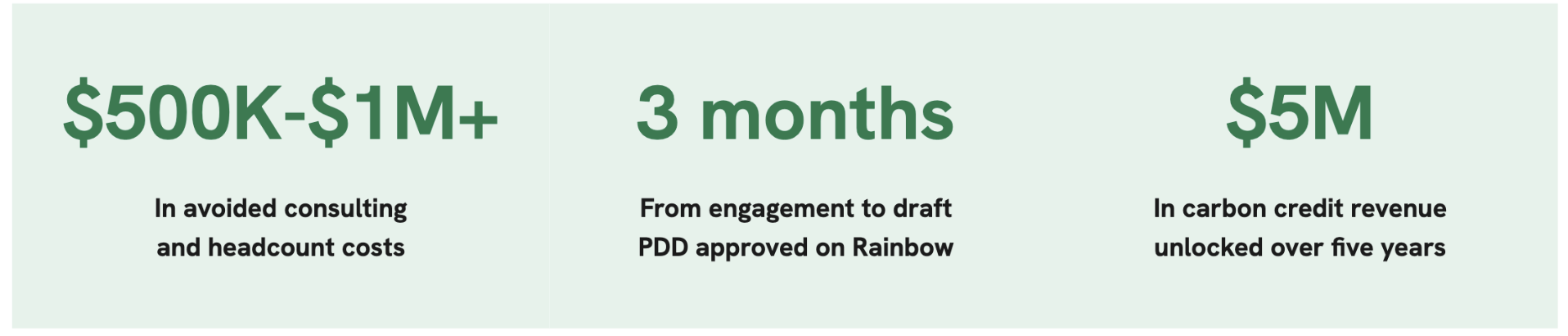
A UK-based biomass power and biochar developer operating in rural Uganda had spent years attempting to navigate carbon credit certification - trying multiple partners and internal approaches without reaching the finish line: a registered biochar carbon removal project. After stepping back to rebuild their internal strategy, Mandulis Energy engaged Offstream and got their first Project Design Document approved on a carbon registry within three months. The result: a project now positioned to finance up to $5 million of its $10 million capital requirement through carbon credits over five years, and fully financed over 10 years in a structure that creates additionality and unlocks access to sustainable, clean energy. Alongside this: avoided consulting and headcount costs of $500K-$1M+, and a development program that had previously made no progress for years now moving to market.
How Mandulis Energy Built Offstream Into Their Business
- Project Design Documents (PDDs): Registry-aligned documentation submitted to and approved on Rainbow within three months of kickoff, after three years of no progress with other partners.
- Registry Strategy: Offstream helped Mandulis Energy sequence its 18-project pipeline across registries, weighing co-benefit alignment and methodology fit, building toward registry diversification as the portfolio and operational maturity grows.
- Data collection and MRV: Offstream presented directly to the on-site team in Uganda to translate carbon market requirements into day-to-day operational actions, embedding accountability for data collection into how the team works day to day.
- What stays in-house at Mandulis Energy: Power plant operations, energy generation and distribution, feedstock logistics, and community engagement.
Biomass Power, Biochar, and Community Impact in Rural Uganda
Mandulis Energy is a UK-headquartered developer building biomass-to-energy and biochar facilities in sub-Saharan Africa. Its flagship project in rural Uganda delivers 24/7 clean electricity to a community that previously had no reliable access to power. The project generates electricity, produces biochar as a byproduct of the power generated through biomass gasifiers, and is registered for both carbon avoidance and carbon removal credits.
When the project was originally conceived in 2017, carbon dioxide removal methodologies didn't yet exist. The project was built as an energy generation asset, biochar was being produced and sitting unused, and carbon credits simply weren't an option. When that opportunity did emerge, it brought with it a pathway to finance up to 50% of the project's capital requirement and replicate the model across an 18-site pipeline. But capturing it required expertise that the Mandulis Energy founding team, experienced across engineering, finance, and operations, did not have in-house.
Kathryn Clark is Mandulis Energy’s Finance Lead, bringing 15+ years of experience in project and financial management and a background spanning sustainability finance. Peter Benhur Nyeko is the Founder and Managing Director, an aeronautical engineer, Unreasonable Fellow, and World Economic Forum Top Innovator who has led Mandulis Energy from its founding. Together they recognized that their strength was building and running projects, not speaking the language of carbon registries.
Three Years of False Starts and Why the Conventional Approach Kept Failing
Before engaging Offstream, Mandulis Energy had spent years trying to get its carbon credit program across the line. The team was introduced to Offstream through a buyer-side contact who recognized that the project would benefit from specialist support, an early signal that independent, expert help was the missing piece.
But the journey was not straightforward. Mandulis Energy had tried multiple paths:
- Specialist science consultants who understood the technical case for the project on paper, but had no expertise translating that into registry-aligned documentation or into a strategy that would survive buyer due diligence.
- Consulting firms who lacked the registry fluency and day-to-day market knowledge required in a young, rapidly evolving sector.
- A first subscription with Offstream in 2023 that paused while Mandulis Energy aligned on its project roadmap and selected from 4-5 project types.Their return, and return specifically to Offstream, spoke to the trust built in that first chapter
The core problem: the team knew they wanted to sell carbon credits, but had not yet mapped the path from where they were to that outcome. And the consultants they had engaged were treating the PDD and LCA as the finish line, not the starting point.
What was missing was not effort. It was someone who understood that the point of a PDD is not just to produce a document, it is a roadmap to generate, sell, and receive cash for a credit. Every step in the process only has value if it is designed with that endpoint in mind.
Mandulis Energy also considered hiring a full-time specialist to own the carbon program internally. But the talent pool they could access kept leading back to the same profiles they had already tried: consultants without registry depth, or science-focused specialists who understood the project but not the market. What the program needed was not one more hire. It was a team that had already taken projects like this all the way through, across multiple registries and multiple geographies.
We've probably got 40 years of experience across engineering, financial management, and operations on the team. But this was just a key area we were missing. Together, Offstream brings that equal 40 years of experience, just in carbon.
— Kathryn Clark, Finance Lead, Mandulis Energy
The Difference Was Simple: Start With the End Goal
Mandulis Energy spent approximately a year doing the hard internal work that no external partner could do for them: getting clear on their strategy, stress-testing their financial model, and making sure that when they came back to the table, they knew exactly what they were trying to build and why.
The decision to engage Offstream came in September/October 2025. The business plan had been rewritten. The financial model was rebuilt. A phased registry strategy was in place, starting with Rainbow, which they had already begun engaging directly. What Kathryn and Peter needed now was the specialist expertise to execute it.
Offstream was chosen for three reasons:
- Outcomes focus: Offstream works backward from credit retirement, not forward from document production. That orientation, designing the PDD to survive buyer scrutiny at the point of issuance, was exactly what had been missing from every previous engagement.
- Registry fluency built in practice: The carbon credit market is young, rapidly evolving, and relationship-driven. Offstream's team is in the market daily, across multiple projects and registries. That live knowledge cannot be replicated by a consultant or built quickly in-house.
- A solution that compounds in value across a pipeline: With 18+ projects in development, Mandulis Energy needed a partner whose work and relationships carried forward from one site to the next - and a platform where data, documentation, and methodology built at site one becomes the foundation for site two. Rather than restarting the learning curve at every new project, each site makes the next one faster and stronger.
That combination was what three years of false starts had been missing.
You start with the end goal, the retirement of the credit, and work backward to the PDD: what needs to be in here to get us there? Most people start the other way around. You have to know the destination, not just the starting point.
— Kathryn Clark, Finance Lead, Mandulis Energy
That orientation shapes not just how Offstream approaches a single project, but how Mandulis Energy thinks about the partnership long term. Even as the team builds its own carbon expertise over time, Kathryn is clear that certification and MRV should always sit with an independent third party. Knowing the destination is one thing. Having an independent party validate you got there is another. It is, as she puts it, the same reason mature companies never audit themselves.
PDD Development, Registry Strategy, and Embedding Carbon Thinking into Operations
Offstream's partnership with Mandulis Energy covers three distinct areas: getting the first project certified on a registry, building a sequenced certification strategy across the wider pipeline, and embedding carbon market awareness and data collection practices directly into on-the-ground operations. None of it is templated. Each requires specialist knowledge built from being in the market every day.
PDD development built for scrutiny, not just submission
Within three months of onboarding, Offstream had Mandulis Energy's first Project Design Document drafted and approved on Rainbow. The process that had defeated every previous approach took 90 days.
The PDD was not designed to simply satisfy a checklist. It was structured to withstand the scrutiny of buyers, auditors, and financing partners, each of whom approaches a project with different questions and different risk concerns. Getting the document right the first time, rather than creating friction through multiple revision cycles, was the goal.
Registry sequencing across an 18-project pipeline
Offstream helped Mandulis Energy develop a sequenced registry strategy across their pipeline. The first stage centered on Rainbow, a strong fit for the project's co-benefits and community impact profile, with a focus on establishing validity, building registry relationships, and gaining practical experience with certification processes. From there, Offstream helped them broaden to both Puro and Isometric for additional sites. Learnings compound into each new project rather than restarting from scratch, and each registry relationship builds on the last.
This approach also addressed a key risk: if different sites in the portfolio were managed by different partners, a single underperforming engagement could create reputational risk across the entire program. One partner, consistent approach, consistent integrity.
Taking carbon thinking into the field
One of the most distinctive elements of the Offstream partnership was a direct presentation to the on-site operations team in Uganda. The purpose: to connect the daily actions of the people running the facility to the revenue those actions ultimately unlock.
The project's data collection disciplines had been built around its original operational setup. Data collection disciplines had been built around that. But carbon credits required field-level operational changes, including timely paperwork, precise biochar quality tracking, and consistent reporting. Getting operators to prioritize data collection for carbon credits required the team to understand why that data matters, not just that it is required. The Offstream presentation made that connection real.
It made it more tangible, more real. This isn't getting lost in translation. It began to expand their sense of ownership.
— Kathryn Clark, Finance Lead, Mandulis Energy
A team that connects their daily work to the revenue it generates does not treat data collection as a burden. They treat it as part of how the project succeeds.
Three KPIs That Moved
Money Saved: $500K-$1M+ in avoided costs
Kathryn's estimate of what the alternative paths would have cost Mandulis Energy:
- Hiring a full-time specialist with the level of registry and market knowledge Offstream brings: $120,000-$150,000 per year at minimum, and even that would not have delivered the market relationships or single-minded focus on getting credits to retirement
- Engaging a larger consulting firm capable of delivering the full program - PDD through to credit sales strategy and retirement: Kathryn's estimate puts this at a minimum of $500,000, likely over $1 million when the full scope is accounted for, based on standard consulting rates and the breadth of work required.
Most developers only price the PDD. Kathryn priced the whole journey, from certification through to credit retirement, including every stage where the wrong partner would have slowed things down or got it wrong.
If we look at all of those pieces, the PDD, the sales side, the delivery side, the retirement side, we would potentially be looking at at least half a million dollars. Probably over a million.
— Kathryn Clark, Finance Lead, Mandulis Energy
Beyond avoided cost, the Offstream partnership is opening up a revenue stream that simply didn't exist before. Carbon credits could cover up to 50% of the project's $10 million capital requirement within five years - and over a 10-year horizon, finance it entirely, creating additionality that unlocks lasting access to sustainable, clean energy.
Time Saved: Three months to PDD approval; three years of false starts ended
The most direct time metric: a process that had made no progress for three years with previous partners was completed within three months of restarting their partnership with Offstream.
The downstream effects of that milestone are also significant. With the PDD and registry listing in place, Mandulis Energy has been able to list on Cloverly, approach insurance providers who required the PDD and LCA to begin their pre-assessment, and move toward financing conversations that were previously unavailable to them. For a project where the PDD is the gating item for insurance, financing, and buyer conversations, every month without it is a month of revenue, relationships, and momentum lost. Kathryn is candid that without Offstream, she is not sure they would have gotten there at all.
Market Credibility: A third party that travels to every conversation
When Kathryn and Peter name Offstream in buyer and investor conversations, it shifts how those conversations go. A recognised independent partner means buyers do not need to bring in as many of their own technical reviewers. What had previously required multiple rounds of technical due diligence from buyer-side reviewers now moves faster: Offstream's involvement reduces the questions buyers need to ask before moving to transaction.
A self-built program invites scrutiny. A recognized independent partner deflects it.
It adds that layer of a third party with skin in the game. Their reputation is on the line too, and that becomes a stopgap for buyers. They don't have to bring on as many technical entities themselves.
— Kathryn Clark, Finance Lead, Mandulis Energy
What buyers and rating agencies are really checking, more than any single number, is consistency. Does the LCA say one thing while the dMRV says another? Does the PDD line up with the operational data? With Offstream owning all three, that consistency is the default rather than something the team has to reconcile every quarter.
In a market where reputation travels fast and scrutiny is only increasing, that signal matters. The question buyers and financiers are really asking is not whether the numbers are right. It is whether they can trust the people and the process behind them. For Kathryn, that willingness to open everything up on a daily basis to scrutiny is not a vulnerability. It is, as she puts it, a greater indication of integrity for a project developer.
Speed at Site One. Scale Across Eighteen.
The carbon removal market moves fast. Opportunities that exist today are gone in three months. Buyers grow more sophisticated by the quarter. And for a project developer with 18 sites in the pipeline, every month of delay at site one is a month of lost momentum across the entire portfolio.
Mandulis Energy's experience with Offstream shows what it looks like to solve that structurally: a PDD approved in three months rather than three-plus years, a project now positioned to unlock millions in carbon credit revenue, and a pipeline of 18 sites with a consistent partner whose work, relationships, and methodology compound from one site to the next.
It's a rapidly evolving market. What you knew yesterday, you don't know tomorrow. If it's going to take you more than three months to do it yourself, the information you're operating on is going to be completely different by the time you get through the process. Bring in the right expertise. And be very honest with yourself, because it's not about getting on the registry. It's about the retirement of the credit.
— Kathryn Clark, Finance Lead, Mandulis Energy
The numbers tell part of the story. But what the financing is actually for is harder to put a number on.
Five years ago, there was no night market. Today, vendors are operating until 10 p.m. These are households that are now able to pay for their kids to attend school, pay for healthcare. Just by delivering access to electricity. That's priceless.
— Kathryn Clark, Finance Lead, Mandulis Energy
Carbon credits are a mechanism for carbon removal. But the more important question is what we do with the investment they generate. By leveraging carbon credits to establish clean energy generation and distribution, Mandulis Energy is laying the foundation for rural communities in Africa that will only ever know clean energy: markets that run through the night, children who can study after dark, families with access to healthcare that was previously out of reach. Getting certification right is what makes that vision real. And the partnership with Offstream has moved Mandulis Energy forward in its mission to advance energy justice, accelerate climate action, and power a prosperous tomorrow.
If you're a biochar or CDR project developer weighing whether to build your own MRV, hire a consultant, or buy a software-only platform, there’s a better path. Build Offstream into your business as your carbon team. Trusted by developers across biochar and other CDR pathways.
You stay focused on building your project. Offstream handles the LCA modeling, the registry-aligned PDD documentation, the MRV implementation and execution, and the independent third-party signal that auditors, buyers, and investors look for on every page.
Why does third-party independence matter for carbon credit certification?
Buyers, registries, and financing partners all apply greater scrutiny to self-prepared documentation. An independent third-party partner with recognized expertise and registry relationships reduces due diligence burden for every counterparty, supports faster deal timelines, and signals that the project developer is committed to transparency and integrity. For Mandulis Energy, naming Offstream as their certification and MRV partner meaningfully reduced the due diligence burden for buyers and financing partners, accelerating conversations that would otherwise have required significantly more back and forth.
When should a project developer engage a certification partner?
As early as possible, but only once you have a clear internal strategy in place. That means knowing your milestones, owning your business plan and financial model, and being clear on what kinds of projects you want to develop and why. Mandulis Energy’s experience illustrates both sides: engaging before having that clarity created unproductive churn; engaging after doing that groundwork enabled a three-month PDD approval.
What separates a consultant who can get you on a registry from one who can get your credits to retirement?
Most consultants treat the PDD and LCA as the finish line. The real finish line is credit retirement: the moment a buyer purchases and retires a credit and cash is received. A consultant who doesn't understand that distinction will produce documentation that looks right on paper but doesn't hold up when a buyer wants to transact. Mandulis Energy experienced this firsthand: previous consultants understood the science and could draft a PDD, but had no framework for what happens after registry approval. The right partner starts at the finish line and works backwards - building every piece of the process, from the LCA to the PDD to MRV, around the moment a credit actually retires.
How does a single partner across a multi-site portfolio reduce risk?
Operational consistency, accumulated knowledge, reputational continuity, and a platform that makes it all repeatable. If different sites use different certification partners, a failure at one site can create doubt across the entire portfolio, even where other sites are performing well. A single partner builds methodology precedents and registry relationships that compound across the pipeline - and a shared platform means the data systems, documentation, and processes built at site one become the foundation for site two, three, and beyond, rather than restarting from scratch each time.
What does the carbon credit revenue opportunity look like for a project like Mandulis Energy?
Mandulis Energy estimates that carbon credit revenue could finance up to 50% of the project's $10 million capital requirement over a five-year horizon. Over a ten-year horizon, a purely debt-financed project could be fully repaid through carbon credits alone, creating a community asset that delivers clean electricity indefinitely with no further external financing required. That outcome only became visible once the project was structured for carbon credit certification, not just energy generation.
What should a developer do if they have not made progress on registry certification?
Step back, and get honest about whether your internal foundations are in place. That means owning your business plan and financial model, knowing your milestones, and being clear on what kinds of projects you want to develop and why. Mandulis Energy spent approximately a year rebuilding those foundations before returning to Offstream, and that preparation meant the second kickoff moved quickly and decisively. The difference isn't how long you wait, it's whether you arrive ready. That clarity is what allows a partner to move fast and get you all the way to credit retirement, not just onto a registry.
Why is it important for carbon certification to remain with an independent third party even as internal capability grows?
Independence is not just about filling a gap in expertise. It is a structural feature of a credible program. Just as mature companies always retain external auditors regardless of how strong their internal finance function is, project developers benefit from having an independent party validate their carbon work. That independence signals to buyers, registries, and financiers that the numbers are not just internally generated and internally approved. For Mandulis Energy, that signal has been a direct factor in unlocking insurance assessments and financing conversations.
.png)