:
Setting the Bar for Indian Biochar: How Ground Up Built Offstream Into Their Business and Earned Pre-Issuance Buyer Confidence
.png)
Setting the Bar for Indian Biochar: How Ground Up Built Offstream Into Their Business and Earned Pre-Issuance Buyer Confidence
Ground Up, a first-of-kind Indian biochar carbon removal developer working with smallholder farmers, wanted an embedded partner that could speak fluently to registries, rating agencies, and buyers without imposing Western assumptions on a Global South project. With Offstream embedded across Life Cycle Assessment (LCA), Project Design Documents (PDDs), and digital MRV (dMRV), Ground Up was selected for Boeing's 2026 carbon removal portfolio before they issued their first credit, cut roughly six months from their project development cycle, and avoided at least one in-house carbon hire in a market where biochar-specific carbon expertise is still developing domestically.
How Ground Up Built Offstream Into Their Business
- Life Cycle Assessment (LCA): Conservative scoping and best-in-class emission factors for a sugarcane leaves and tops biochar project across a decentralized smallholder-farmer supply chain.
- Project Design Documents (PDDs): Registry-aligned PDD writing and re-writing as project parameters and standards have evolved, always contextualizing decisions rather than starting from scratch.
- Monitoring, Reporting, and Verification (MRV): Registry-aligned reporting and integration built on Ground Up's own field data, translating real-time biomass and biochar measurements from a decentralized smallholder supply chain into audit-ready documentation.
- What stays in-house at Ground Up: Building the supply chain, operating the biochar facilities, engaging directly with rural farmers, the field data collection layer, and the field operations behind the data. The carbon credit translation layer is outsourced.
Setting the Standard for Biochar in the Global South
Ground Up is an Indian biochar carbon dioxide removal (CDR) developer. The company's flagship project, Project Nandani, originally relied on bagasse, a centralized feedstock from sugar mill operations, before pivoting to sugarcane leaves and tops: a decentralized agricultural residue collected directly from smallholder farmers.
Ground Up's co-founders, Rhea Dabriwala, Naveen Shivalingham, and Shanay Jhaveri, came up through voluntary carbon markets on the avoidance side, watching the REDD+ era damage reputations across the market. They knew from the start that as one of the first Indian CDR biochar developers, their responsibility was to set the standard for what biochar quality could look like coming out of the Global South.
That standard required a partner who spoke the language of carbon removal registries fluently, who understood that smallholder data collection has different logistics than centralized feedstock systems, and who could carry a cohesive story across the LCA, the PDD, and the dMRV without contradictions.
A New Market, a Higher Bar, and a Still-Developing Domestic Expertise Pool
When Ground Up began designing Project Nandani, the challenge was infrastructure. The Indian biochar landscape was effectively new. India had a strong community of climate scientists, agronomists, and carbon market consultants, but very few practitioners with hands-on experience taking a biochar project from feasibility through registration, verification, and issuance. The supply chain was decentralized and smallholder-driven. Every methodology, every emission factor, every standard had been written for contexts that did not always map cleanly.
Rhea's team approached the question from first principles. On their first project, the risk was highest. They could aggregate fractional consultants (an LCA expert, a registry consultant, an MRV specialist) and try to coordinate the pieces themselves, or they could find a third-party MRV partner who had already built the full stack.
Going alone was about whether the project would be credible enough to set the standard Ground Up wanted to set. Hiring in India would have meant compromising on biochar-specific experience, since that domestic specialist pool was still nascent. Hiring abroad would have meant compromising on cost. Neither path produced the kind of cohesive, audit-ready documentation that a project like Nandani would need to hold up to rating agencies, registries, and the buyers Ground Up wanted to attract.
In a market as new as Indian biochar, no first-time developer gets through verification and issuance without external expertise. For us, going alone wasn't tedious - it was untenable.
— Rhea Dabriwala, CEO & Co-founder, Ground Up
Choosing Cohesion Over Components
Ground Up evaluated several biochar MRV providers. The decision came down to one question Rhea kept returning to: do you want every part of your project to come from a different vendor, or do you want one partner whose work is consistent across the LCA, the PDD, and the dMRV?
Software-only platforms could not deliver that. A platform built to cover every biochar project in the world is, in Rhea's words, "functionally impossible" given how early the market is and how nuanced individual projects are. Ground Up also wanted credit documentation and credit sales to sit with separate teams, a structural choice that lets buyers, registries, and rating agencies evaluate each independently. Plenty of biochar developers prefer a bundled approach for the commercial reach it gives them. For Ground Up, the separation was the point.
Offstream stood out for three reasons:
- Domain expertise across the full stack: The Offstream team brought deep expertise in carbon, with agronomic and climate science backgrounds that translated directly to project decisions. Ground Up was getting people who had already done the work, not just software.
- Fixed pricing for well-defined offerings: Transparent, fixed pricing for early-stage feasibility, LCA, PDD, and MRV, rather than a percentage of credit revenue that would balloon at scale.
- No marketplace conflict of interest: Offstream focuses exclusively on documentation. Credit sales sit with the developer, which was the structural separation Ground Up wanted.
Having transparent and concrete long-term pricing for very well-defined offerings made it much easier to engage with Offstream versus another competitor.
— Rhea Dabriwala, CEO & Co-founder, Ground Up
One Team, One Cohesive Story Across LCA, PDD, and dMRV
Ground Up describes Offstream as "a consistent thread throughout the project." That value shows up across the LCA, the PDD, and the dMRV: three functions that must align.
Conservative LCA modeling with best-in-class emission factors
Offstream built Ground Up's biochar LCA to a standard that would hold up against any registry, buyer, or rating agency. That meant conservative scoping, best-in-class emission factors, and an LCA model that could be re-run as the project pivoted, most notably when Ground Up moved from a centralized bagasse feedstock to decentralized sugarcane leaves and tops.
That kind of pivot is exactly where in-house MRV breaks down. Re-running the LCA from scratch would have taken months. With Offstream's model, Ground Up could swap inputs and have a re-modeled LCA in under two hours.
For the next project with the same feedstock, I can spin up a complete LCA in under two hours just by swapping inputs into Offstream's model. Each new facility starts from a defensible baseline instead of a blank page.
— Rhea Dabriwala, CEO & Co-founder, Ground Up
PDD writing built around context and continuity
When Ground Up read PDDs that already existed in the public domain, they came away convinced they could do better. Offstream helped them restructure their own PDD to set context at every step, explaining decisions, anchoring them in evidence, and building a documentation trail that would still make sense if the registry, the standard, or the project parameters shifted.
That continuity has mattered. When standards have evolved and registry requirements have changed, the underlying narrative has stayed coherent because the same team iterated across versions.
A digital data collection layer designed for smallholder reality
Ground Up built and owns their data collection layer - real-time biomass and biochar measurements gathered directly from smallholder farmers across a decentralized supply chain. Offstream's role is the bridge: taking that field data and translating it into registry-aligned, audit-ready reporting that meets the same bar as any international developer.
Our reporting has to meet the same bar as any international developer's. The smallholder supply chain is what makes the work harder, and what makes the integrity of the data more important.
— Rhea Dabriwala, CEO & Co-founder, Ground Up
Strategic flexibility when external conditions change
Standards, methodologies, and registry frameworks have all evolved quickly through 2024–2026. Ground Up has navigated more than one of those moments alongside Offstream, including a mid-development change in registry approach that required transferring the full documentation stack on short notice. That kind of pivot is difficult for any early-stage developer to execute alone.
When the registry landscape shifts, to immediately have the confidence that there's an alternative ready, and to know we can transfer all of that information overnight with Offstream, that's what makes it possible to succeed.
— Rhea Dabriwala, CEO & Co-founder, Ground Up
Four KPIs That Moved
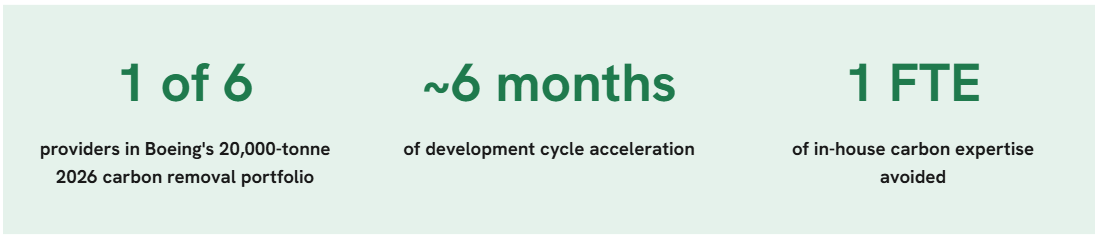
Money Saved: 1 FTE of in-house carbon expertise avoided, plus pricing protection at scale
Ground Up estimates that replicating Offstream's combined LCA, PDD, and MRV expertise in-house would have required at least one dedicated carbon FTE, with biochar-specific experience that is still developing domestically in India and would have to be hired abroad. Beyond the headcount, the company avoided the commission-based pricing structure common to marketplace-bundled MRV providers, a structure that becomes the single largest line item on a project once credits start moving.
For an early-stage biochar project developer, fixed pricing is the difference between economics that work at one facility and economics that work at twenty.
What Offstream takes off our plate isn't just hours of work. It's the cognitive cost of checking every approval, every methodology adjustment, every requirement. That's where the time and money actually compound.
— Rhea Dabriwala, CEO & Co-founder, Ground Up
Time Saved: ~6 months of development cycle acceleration
By Ground Up's own estimate, going the DIY-plus-fractional-consultant route would have extended the project timeline by approximately six months. That figure reflects the time it takes to find the right consultants, coordinate them, verify their advice, and reconcile contradictions between their outputs, time that compounds at every registry submission, every methodology update, and every project iteration.
Offstream compressed that loop by sitting inside the project rather than outside it. When standards have shifted or requirements have changed, the documentation translates across versions without manual re-work each cycle.
Peace of Mind: Confidence to Pivot, Innovate, and Advocate
Some of Offstream's value shows up in moments Ground Up did not have to manage. A mid-development registry transition. A standards revision. A rating agency asking a clarifying question. Each of these would have been a crisis for a developer working alone. With Offstream embedded, they were resolved in days.
That confidence has compounded. When Ground Up pivoted from bagasse to sugarcane leaves and tops, moving from a centralized feedstock to a decentralized smallholder supply chain, they did it knowing Offstream had already vetted eligibility. When their rating agency raised a methodology question, Offstream went to the table with them to walk through the reasoning.
Offstream goes to the rating agency and back to the registry with us every time, making the case for why each methodology choice holds up. That's what a consistent thread across a project looks like.
— Rhea Dabriwala, CEO & Co-founder, Ground Up
Market Credibility: Pre-Issuance Buyer Confidence and Higher Project Ratings
The most visible proof of Offstream's impact on credibility is the company Ground Up keeps. In May 2026, Ground Up was selected as one of 6 providers in Boeing's 20,000-tonne 2026 carbon removal portfolio, procured through Supercritical and evaluated against their 118-point scientific vetting framework. Ground Up was identified through Supercritical's supply development program, which works with early-stage projects to get them to the quality and scale that enterprise buyers require. Ground Up was the only project of its profile in the cohort, included while still pre-issuance and without a track record of issued credits, alongside five providers that were already issuing. The audit package behind that selection (the LCA, the PDD, the rating documentation) was built on materials Offstream had been co-developing with the team for months.
The ratings progression tells the same story. With each pre-rating round, Ground Up has climbed the scale, backed by Offstream's evidence and direct agency engagement, with further upgrades targeted in the final rating.
Boeing's pre-issuance selection of Ground Up is a verdict on the audit package Offstream helped build, and on the team's ability to deliver.
— Rhea Dabriwala, CEO &Co-founder, Ground Up
What buyers and rating agencies are really checking, more than any single number, is consistency. Does the LCA say one thing while the dMRV says another? Does the PDD line up with the operational data? With Offstream owning all three, that consistency is the default rather than something the team has to reconcile every quarter.
For New-Market Developers, the Story Has to Be Tight Across Every Document
The biochar carbon removal market is still being defined, especially outside North America and Europe. Buyers in their learning phase are comparing the developers who can articulate a coherent story across every document, every standard, and every conversation, against the ones whose narrative falls apart under audit.
For an Indian biochar developer with a decentralized smallholder supply chain and an ambition to set the standard, that coherence is not optional. It has to live in the LCA, the PDD, the dMRV, and the rating package simultaneously, and be defensible to any international buyer without flattening the project's local context.
Ground Up's experience with Offstream shows what that looks like in practice. A documentation stack that holds up under audit. A partnership that scales as the portfolio grows. A project that earned pre-issuance buyer confidence in a category India is still building at registry scale.
What sets Offstream apart is not only the technical work. It's the honesty, the ownership, and the pride they take in every project. For any biochar or CDR developer evaluating partners, it's a no-brainer.
— Rhea Dabriwala, CEO & Co-founder, Ground Up
If you're a biochar or CDR project developer weighing whether to build your own MRV, aggregate fractional consultants, or work with a software-only platform, there's a better path. Let Offstream be the embedded carbon expertise from day one, trusted by developers across biochar and other carbon removal pathways, in markets from Karnataka to Kenya to California.
You stay focused on building your project. Offstream handles LCA modeling, PDD writing, and dMRV implementation, and the registry-fluent reputation that buyers, auditors, and investors look for on every RFP.
How does Offstream handle biochar projects in the Global South?
Ground Up's Project Nandani is a smallholder-farmer biochar project in India, a context where data collection, supply chain decentralization, and feedstock variability create challenges that don't show up the same way in centralized projects. Offstream built a digital MRV data collection layer specifically for that reality, so the project can report to the same standard as any international developer without falling back on assumptions or estimations.
Does an MRV provider need to also be a marketplace?
No. Both models exist in biochar MRV, and both work for different developer profiles. Bundled MRV-plus-sales providers can give projects commercial reach alongside the documentation work. Independent MRV providers like Offstream focus exclusively on documentation, which keeps each function evaluable on its own terms by buyers, registries, and rating agencies. For Ground Up, that structural separation was part of why Offstream was the right partner, alongside the fixed pricing structure.
How should I evaluate MRV pricing structures?
Biochar MRV pricing typically comes in two shapes: fixed fees for clearly scoped deliverables or milestones, and commission as a percentage of credit revenue. Commission can be attractive at the pre-issuance stage when there's no revenue yet, but it tends to scale against the developer once credits start moving. For developers planning to scale to multiple sites, fixed pricing for well-defined offerings tends to compound in their favor.
What does it mean to “set the bar” in a new biochar market?
When a category is early, every project sets a precedent. A weakly documented project shapes how buyers, registries, and rating agencies think about the entire category. For Ground Up, building Offstream into the business was a way to set a precedent that other Indian biochar developers, and other Global South CDR projects, could build on.
How does an LCA, PDD, and MRV stack stay consistent across registry changes?
When the same partner owns all three layers, a change in registry requirements gets translated through the stack automatically. The LCA framework, the PDD narrative, and the dMRV implementation update together, rather than requiring the developer to reconcile contradictions across vendors. Ground Up has navigated multiple methodology and registry changes this way without the documentation falling out of alignment.
How fast can a third-party MRV partner support a pre-issuance buyer deal?
For Ground Up, the audit package that supported a major pre-issuance buyer deal was built over months of co-development with Offstream, covering the LCA, the PDD, and the rating documentation. The deal itself was concluded in a span of days once the materials were ready. The pattern is consistent: developers who invest early in defensible documentation can move very fast when an opportunity appears.
Is a US-based MRV partner a fit for an Indian project?
Ground Up's experience suggests yes, provided the partner is willing to invest in local context. The risk wasn't time zones. It was the possibility of having a partner impose assumptions on a project that operates differently. Offstream traveled to India and built the kind of contextual understanding that lets them ask better questions and translate the answers without flattening the project.